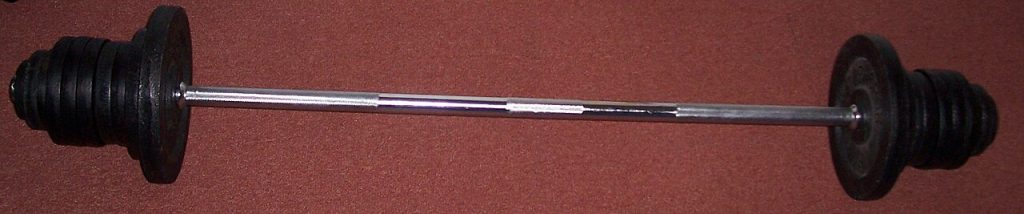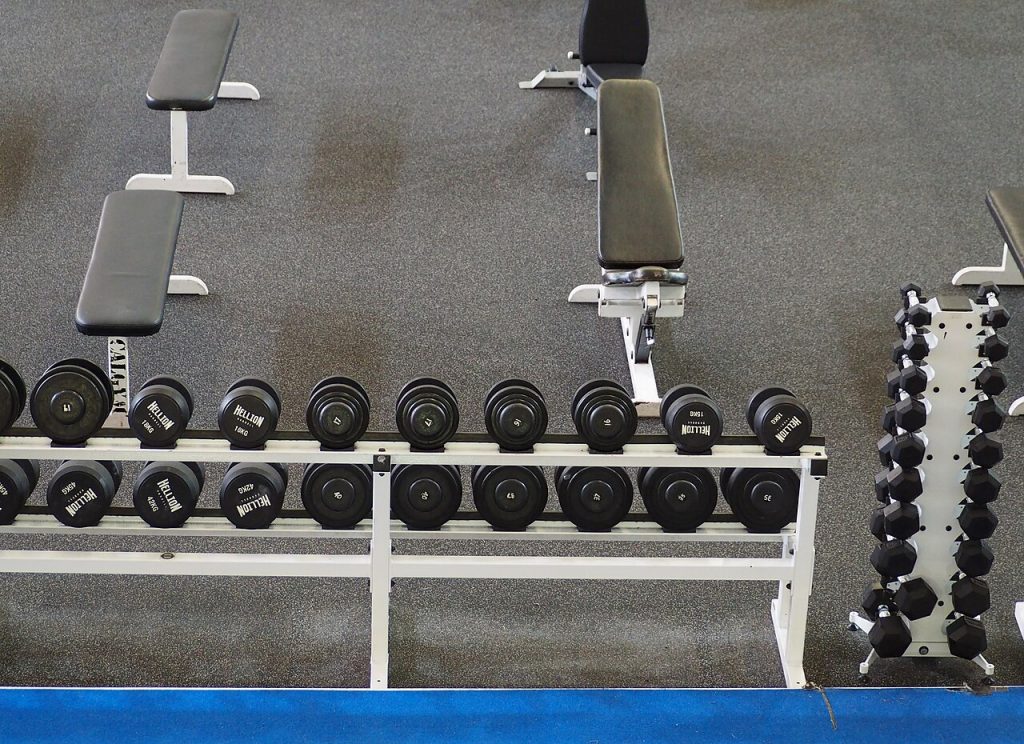
If you cannot use a heavy barbell today, is the session useless for muscle growth? No. Lighter loads can support hypertrophy, provided the working sets involve meaningful effort. That does not mean every feather-light movement works equally well, or that heavy training has no place. Many studies comparing loads had participants perform challenging sets, often close to the point where another repetition was not possible. Your decision should begin with the goal: gaining muscle, improving maximum strength, learning a movement, or working within available equipment.
“Light” and “heavy” are relative to what a particular person can lift for one repetition in a particular exercise (one-repetition maximum, or 1RM). They are not universal kilogram labels. A 20 kg squat may feel easy for one person and demanding for another. An actual maximum test is not required to apply this idea; technique and range of motion affect the number too. Use the load-selection guide and compare sessions on the same equipment under similar movement conditions.
What the research says—and does not say
A 2017 meta-analysis by Schoenfeld and colleagues pooled 21 studies comparing loads at or below 60% of 1RM with loads above 60%. The included protocols took sets to momentary muscular failure. The analysis did not detect a clear difference in measured hypertrophy between load groups, while improvements in 1RM strength favored heavier training. “No statistically clear difference” is not proof that every loading approach is identical for every person. Nor should a demanding low-load set be confused with a few easy warm-up repetitions.
Lopez and colleagues’ 2021 network meta-analysis examined 28 studies with 747 healthy adults. It classified low load as more than 15 repetition maximum (RM), moderate load as 9–15 RM, and high load as eight or fewer RM. The included protocols reached volitional failure. The pooled hypertrophy comparisons found no clear difference across these groups, whereas moderate and heavy loads produced larger strength gains than low loads. Participants, exercises, intervention lengths and measures of muscle size varied, so the analysis cannot tell us that any number of repetitions works equally well or that light is automatically safer.
The American College of Sports Medicine’s 2026 overview of reviews identified heavier loads of at least 80% 1RM as favorable for voluntary strength in healthy adults. For hypertrophy, it highlighted other programming variables, including weekly volume, rather than a single indispensable loading zone. Most interventions lasted weeks or months, not years. They cannot settle whether one loading zone alone is best indefinitely. Results synthesized in healthy adults also do not prescribe loads for someone with an injury or a medical condition.
Light does not necessarily mean easy
With a lighter load, reaching a challenging level of effort often takes more repetitions. The set may take longer and create substantial local discomfort or breathlessness. If the aim is a hypertrophy-oriented working set, distinguish a handful of easy movements from a set performed with effort while technique stays controlled. Still, every set need not end in failure. As the guide to repetitions in reserve (RIR) explains, estimating reps left is imperfect; exercise safety and the quality of later sets matter.
There is less reason to assume that extremely small loads behave like the low-load groups studied in trials. “Low load” is not the same as moving without meaningful resistance. If only light dumbbells are available, ask whether you can perform stable repetitions, how long the set takes, and whether it becomes challenging without losing control. If very high repetitions make the movement sloppy or the session impractical, a different implement, exercise or load may be more useful.
A comparison based on the job the set must do
The table is an editorial example using one person on the same chest-press machine. The weights are illustrative, not a prescription. Different machines may display the same number while providing different resistance.
| Main goal or situation | Possible approach | Check during the set |
|---|---|---|
| Practise maximum strength | On the familiar machine, 40 kg for six reps, two or three sets | Rest adequately; repeat the same range and technique |
| Aim at muscle gain with less load | On the same machine, 30 kg for 12–15 reps, two or three sets | Keep the target movement controlled through the final reps |
| Learn the movement first | Use a lighter load for practice | Prioritize stability and the machine’s safety instructions over an RIR number |
Twelve to 15 repetitions is not the one required hypertrophy range. Six reps at 40 kg is not inherently “advanced,” and 15 at 30 kg is not inherently “beginner.” If extra repetitions come only by changing the range of motion or losing control, do not regard the sets as equivalent. Conversely, if a lighter load lets you perform repeatable working sets and your reps or load improve over several weeks, it can be a productive option.
How beginners and experienced lifters might use the choice
Beginners do not need a heavy 1RM test before training. Start with a load that permits learning the movement and completing controlled working sets, then adjust after several sessions. With dumbbells, check left-right stability; with machines, repeat seat and start positions. If technique is unstable under a light load, merely increasing the weight does not solve the problem.
Experienced lifters can use heavier days to practise strength and moderate or lighter work when it better fits an exercise or their fatigue. Mixing rep ranges is not, by itself, proof of faster muscle growth. A heavy squat on one day and a somewhat lighter leg press on another can be a practical choice based on the demands of each exercise. Keep the target muscle’s weekly sets and recovery in view rather than changing every variable at once.
A four-week check you can actually run
Choose one exercise. In week one, record the exact machine or implement, seat position if applicable, range of motion, rest time, load, repetitions, sets and an approximate effort rating. For the next three or four weeks, keep the main conditions reasonably similar. Ask whether you can complete more repetitions with the same load and technique, or raise the load slightly without sacrificing your movement. An illustrative log might shift from 30 kg for 12, 11 and 10 reps to 15, 14 and 12 reps under comparable conditions. That is a useful sign of progress; it is not a precise measure of new muscle tissue.
If sets of 20-plus repetitions are so long or unpleasant that you cannot sustain them, consider a heavier load and fewer reps. If increasing load makes your movement unreliable, return to a weight you can control and build from there. Do not push through pain or dizziness; seek appropriate professional advice when needed. A weekly log review helps you look beyond the kilogram number to technique and fatigue.
TRAINING PRESS and GROWTH are both operated by GOODBOY STUDIOS. Logging load, reps and sets in GROWTH lets you compare what happened at your chosen load with the previous session. Add a note about perceived effort or technique where the app allows it. We do not claim the app can diagnose hypertrophy or guarantee an optimal load.
Frequently asked questions
Is a set useless if I can do more than 20 reps?
No. Studies have included high-repetition, low-load conditions. Its practicality depends on time, effort, technique and your goal. There is no need to force an extreme rep count.
Does heavier always build muscle faster?
The pooled research does not show that heavier is faster for everyone’s hypertrophy. Heavy-load practice has a clearer advantage when maximum strength is the priority.
Are light weights always safe for my joints?
No. Repetition count, movement and existing symptoms affect the experience. This article cannot diagnose pain or prescribe treatment.
Takeaway
A challenging working set with a lighter load can contribute to muscle growth. Heavier loads are useful for maximal-strength practice, while light loads carry their own time and fatigue costs. Choose with your goal, technique, effort and ability to continue training in mind. Then compare several weeks of repeatable sessions instead of chasing a magical weight or rep range.
References
- Schoenfeld BJ, et al. Strength and Hypertrophy Adaptations Between Low- vs. High-Load Resistance Training: A Systematic Review and Meta-analysis. Journal of Strength and Conditioning Research. 2017;31:3508–3523. doi:10.1519/JSC.0000000000002200. https://pubmed.ncbi.nlm.nih.gov/28834797/
- Lopez P, et al. Resistance Training Load Effects on Muscle Hypertrophy and Strength Gain: Systematic Review and Network Meta-analysis. Medicine & Science in Sports & Exercise. 2021;53:1206–1216. doi:10.1249/MSS.0000000000002585. https://pubmed.ncbi.nlm.nih.gov/33433148/
- Morton RW, et al. Neither load nor systemic hormones determine resistance training-mediated hypertrophy or strength gains in resistance-trained young men. Journal of Applied Physiology. 2016;121:129–138. doi:10.1152/japplphysiol.00154.2016. https://pubmed.ncbi.nlm.nih.gov/27174923/
- Currier BS, et al. American College of Sports Medicine Position Stand. Resistance Training Prescription for Muscle Function, Hypertrophy, and Physical Performance in Healthy Adults: An Overview of Reviews. Medicine & Science in Sports & Exercise. 2026;58:851–872. doi:10.1249/MSS.0000000000003897. https://pubmed.ncbi.nlm.nih.gov/41843416/