You may have heard that every muscle needs ten sets a week, or that more sets always mean more growth. Neither statement is a good reason to double your program overnight. Weekly sets are a useful way to describe training volume, but ten sets can represent very different work depending on the exercise, effort, range of motion, rest, experience, and recovery. A better starting point is to count what you already do consistently, follow your performance for several weeks, and then decide whether to change it.
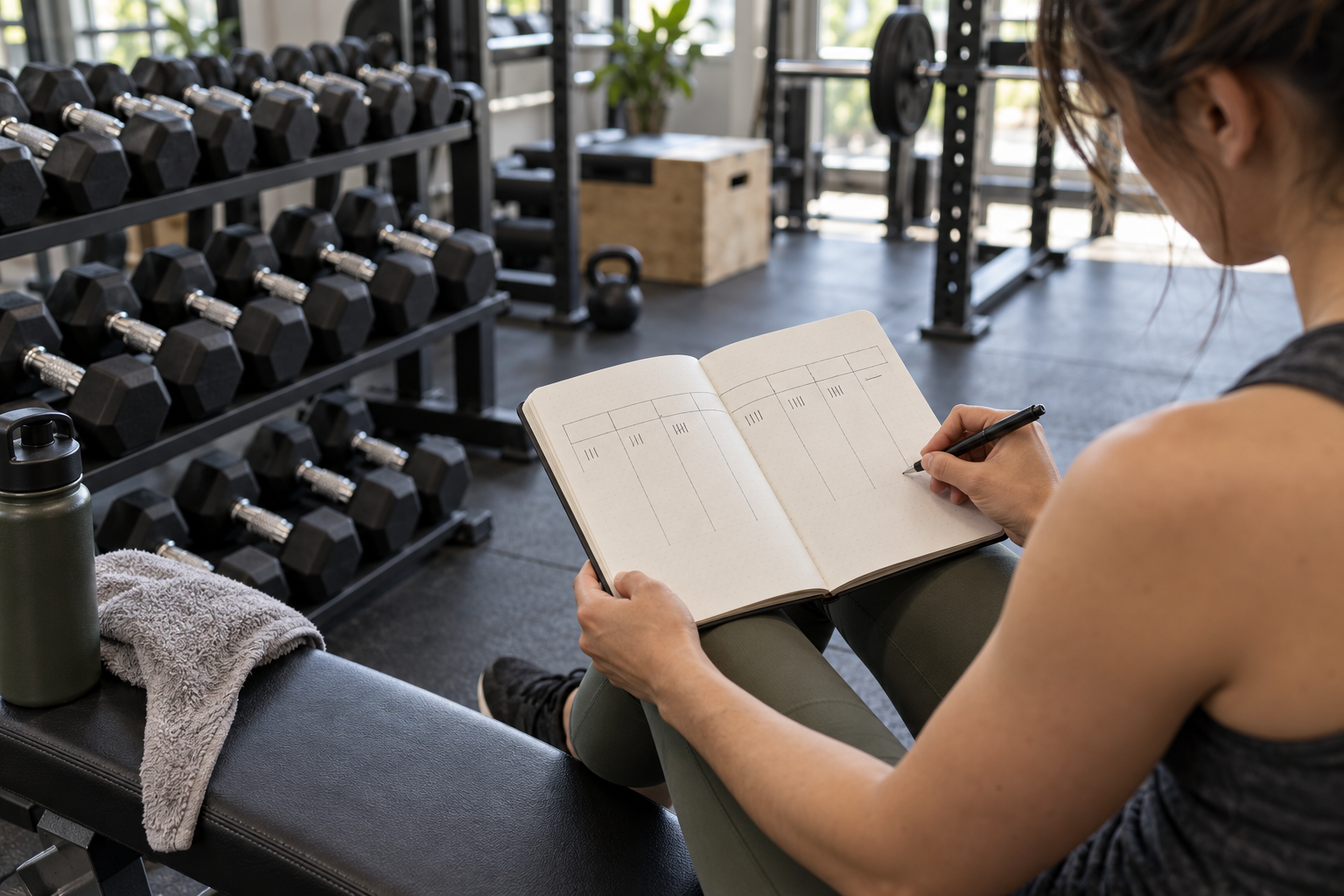
Here, weekly sets means the number of working sets aimed at a muscle over seven days. Counting every light warm-up or technique rehearsal inflates the number. Conversely, a compound movement such as a bench press challenges more than the chest: the triceps and shoulders contribute too. Keep a simple tally of direct sets for the main target muscle, and note the work other muscles receive separately. That distinction makes the log easier to interpret.
The research does not say that every extra set is worth it
A 2017 meta-analysis by Schoenfeld and colleagues combined 34 treatment groups from 15 studies and found a general relationship between more weekly sets and greater hypertrophy. It did not establish a personal optimum for every lifter. A meta-regression published by Pelland and colleagues in 2025 likewise found a positive association between volume and muscle size, while suggesting diminishing returns as volume rises. Its analysis compared ways to count direct and indirect sets; counting indirect sets as half-sets fit the data best. That is an analytic convention, not proof that one bench-press set delivers exactly half a triceps set to every individual.
A 2026 American College of Sports Medicine overview of reviews found that muscle growth tended to be greater with relatively higher volumes, including around ten or more weekly sets. That is a population-level guide, not a switch that turns on at set ten. Some people improve with less; others add work without a worthwhile improvement, while fatigue and time costs grow. Most evidence concerns healthy adults. It should not be applied unchanged to someone with an injury or a medical condition.
Define a working set before you count one
For a meaningful comparison, primarily count sets that target the muscle, use controlled technique, and demand a reasonable effort. Record warm-ups with many repetitions in reserve and sets intended mainly for balance or skill separately. Training to failure on every set is not required. Use our guide to RIR and training to failure to record an effort estimate alongside the load, repetitions, and movement conditions.
For example, three bench-press sets and three dumbbell-press sets aimed at the chest can initially be logged as six direct chest sets. Three triceps press-down sets that same week do not belong in the chest tally. For the triceps, the press-downs are three direct sets; the presses also create indirect work, which you can note in a separate column. You need not assign a precise decimal to that indirect work to notice that a press-heavy week might explain tired arms.
An example spread across two days
The table is an editorial example of how to count chest working sets, not a universal prescription. Splitting the work between Monday and Thursday can make technique and repetitions easier to observe than cramming all the sets into one session. It does not establish the ideal frequency. Adapt the days to your own schedule.
| Day | Exercise | Direct chest sets | What to check |
|---|---|---|---|
| Monday | Bench press: 3 sets; machine chest press: 2 sets | 5 | Does range of motion shrink in later sets? |
| Thursday | Dumbbell press: 3 sets; cable fly: 2 sets | 5 | Compare load, repetitions, and technique with last time |
| Weekly total | Four exercises | 10 | Also note shoulder or elbow discomfort and recovery |

Ten is used here because it makes the arithmetic clear. If you are progressing on four weekly sets, there is little reason to jump straight to ten. If your results have stalled for several weeks under comparable conditions and sleep, food, and rest have been fairly stable, a small increase might be worth testing. If later sets deteriorate because rest periods are too short, review rest between sets before adding work.
When to add, hold, or reduce sets
For the first two to four weeks, keep exercise choice and weekly placement reasonably consistent. Record direct sets by muscle, load, repetitions, an approximate RIR, and any changes in movement. If repetitions improve at the same load and technique on six weekly sets, maintaining six is a defensible decision. If performance stalls, do not react to one bad day by increasing volume. Check rest between sets, sleep, nutrition, and fatigue from other activities first. When several weeks of stagnation remain despite those checks, and you are free of persistent joint discomfort or marked carry-over fatigue, try adding one or two weekly sets for the target muscle and observe another few weeks. That increment is an editorial way to keep the experiment interpretable, not an exact dose established by research.
If repetitions or range of motion drop sharply in later sets, the planned schedule becomes difficult to maintain, or discomfort persists, rethink how the work is distributed before piling on more sets. Stop training through pain and seek a qualified clinician’s advice when appropriate. A temporary reduction in sets can also be useful when recovery seems inadequate. Do not judge whether a program worked solely by how sore you feel.
Turn the number into a useful log
TRAINING PRESS and GROWTH are both operated by GOODBOY STUDIOS. Logging weights, repetitions, and sets by exercise in GROWTH gives you material to compare last week with this one. We are not claiming that the app automatically totals direct and indirect sets by muscle. If needed, make that distinction in your own notes or table, and use our weekly training-log review to ask whether there is a real reason to increase volume. Check the nutrition and recovery foundations in the basics of muscle growth alongside the set count.
Common questions
Can I build muscle with fewer than ten sets a week?
Yes. Ten is a guide derived from pooled research, not a minimum threshold. Beginners and people coming from a low-volume program may improve with fewer sets. Let your own consistently measured progress inform the next step.
Are three squat sets automatically three quadriceps sets?
Counting them as direct sets for a muscle you primarily target is a workable starting point. The stimulus still depends on range of motion, technique, load, and the contribution of other muscles. Treat the tally as a consistent planning measure, not a precise physiological measurement.
Should my set count rise every week?
No. Keep the current amount if it is working. If an increase adds fatigue or time without a worthwhile change in results, returning to the earlier amount can be reasonable.
Takeaway
Weekly sets can help you plan for hypertrophy, but there is no single fixed optimum. Separate direct work from indirect work, count sets under repeatable conditions, and first see what your present volume is doing. Test small changes and judge them against several weeks of performance and recovery.
References
- Schoenfeld BJ, Ogborn D, Krieger JW. Dose-response relationship between weekly resistance training volume and increases in muscle mass: A systematic review and meta-analysis. Journal of Sports Sciences. 2017;35:1073–1082. doi:10.1080/02640414.2016.1210197. https://pubmed.ncbi.nlm.nih.gov/27433992/
- Pelland JC, et al. The Resistance Training Dose Response: Meta-Regressions Exploring the Effects of Weekly Volume and Frequency on Muscle Hypertrophy and Strength Gains. Sports Medicine. 2026;56:481–505. doi:10.1007/s40279-025-02344-w. https://pubmed.ncbi.nlm.nih.gov/41343037/
- American College of Sports Medicine. Resistance Training Prescription for Muscle Function, Hypertrophy, and Physical Performance in Healthy Adults: An Overview of Reviews. Medicine & Science in Sports & Exercise. 2026. https://pubmed.ncbi.nlm.nih.gov/41843416/
- Schoenfeld BJ, et al. Resistance Training Volume Enhances Muscle Hypertrophy but Not Strength in Trained Men. Medicine & Science in Sports & Exercise. 2019. https://pubmed.ncbi.nlm.nih.gov/30153194/