The same “30 kg chest press” can feel different if the seat is lower than last time, your back comes away from the pad, or the starting position is deeper. Before deciding that a change in repetitions means progress or regression, make sure the movement conditions are comparable. For a beginner, learning how to set up the machine is part of learning the exercise.
These are general steps, not a substitute for the instructions on a particular machine. Adjustments and mechanisms vary by manufacturer and model. Follow the equipment label and your facility’s guidance, and ask a staff member if anything is unclear. This is not a method for exercising through pain or dizziness.
Four checks before the first working set
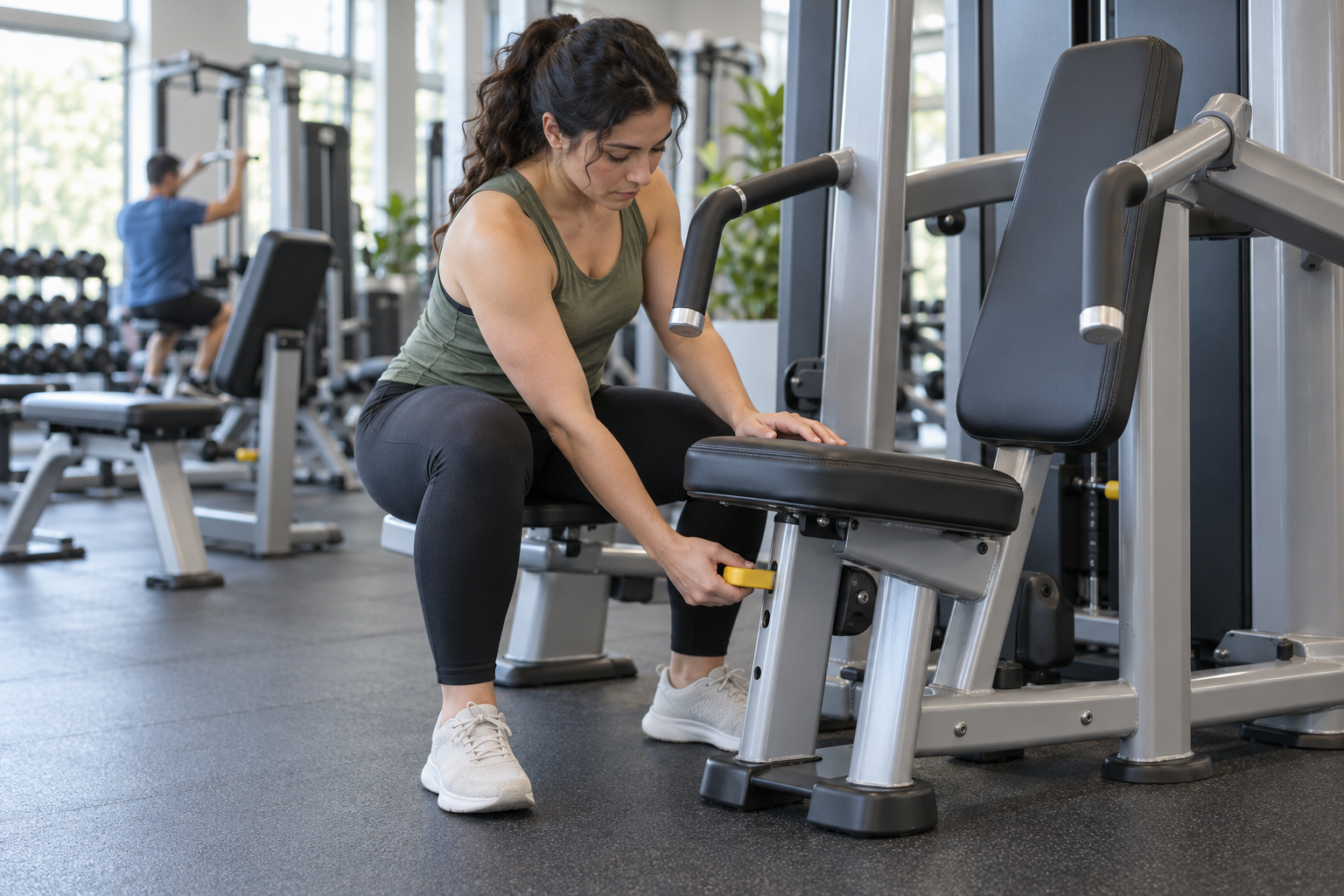
Identify the intended movement and the parts you can adjust. Move a seat, backrest, or start-position pin only when the mechanism is unloaded as directed, then confirm that the pin or lock has engaged. Set your torso, grip, and feet before trying a few repetitions with a light load. Choose the working weight last. Some machines have independent arms; others display pounds rather than kilograms. Matching one number from a different machine is not enough to reproduce an exercise.
| Order | Check | Example note |
|---|---|---|
| 1 | Machine and model | “Chest press A”; do not combine its records with another machine |
| 2 | Seat, backrest, and start position | “Seat 3, start 2”; if there are no markings, describe the position |
| 3 | Torso, hands, and feet | Back supported and feet placed consistently |
| 4 | Light trial and load | Test a comfortable motion, then select the working load |
This is an editorial checklist, not an exact standard shared by all equipment. If you switch machines, record the set as a different exercise even if both displays say “30 kg.”
A seated chest-press example
On a seated chest press, begin by finding a position where the handles are roughly aligned with mid-chest. The American Council on Exercise’s exercise guide also advises supporting the back, stabilizing the feet, and aligning the handles around mid-chest. The trajectory and comfortable setting depend on the machine and your body, so there is no seat number that fits everyone. If the start position causes shoulder pain or forces an uncomfortable stretch, change the setting or load and ask staff for help when needed.
While pressing and returning with a light load, notice whether your wrists bend sharply, shoulders rise, or back lifts off the pad. Control the return rather than letting momentum do it. “Shorter is always safer” and “deeper is always better” are both oversimplifications. Reviews of range-of-motion research have found advantages to training at longer muscle lengths for some muscles, but outcomes differ by exercise and measurement site. They do not establish a universal machine setting or range for every person. Start with a controllable, pain-free range you can reproduce and record.
Do not copy chest-press settings to every machine
Handle height relative to the chest is not a setup rule for a leg press or lat pulldown. On a leg press, seat and backrest position, foot placement, and the start position influence the movement. You do not need to force an extremely deep knee angle. If your pelvis and lower back lift substantially from the support, reconsider the setup and load. On a lat pulldown, check the thigh pad and use a grip width you can repeat. Give priority to the instructions on the specific model and ask facility staff about uncertainties.
Do not use equipment if you cannot find a suitable position, the adjustment pin will not lock, or a cable appears damaged. Tell staff; do not attempt repairs yourself. Stop a set if pain appears suddenly, and seek appropriate medical advice if necessary.
A change in setup changes the meaning of the log
Imagine pressing eight repetitions last week with the seat at “3” and ten this week with the seat at “1.” From those numbers alone, you cannot tell whether your strength improved or the exercise changed. First compare the seat, start position, grip, range, and rest interval. If they are reasonably consistent and repetitions rise at the same load, the change is easier to interpret. Our guides to choosing a training load and using RIR help you compare effort and technique, not just the displayed weight.
TRAINING PRESS and GROWTH are both operated by GOODBOY STUDIOS. GROWTH lets you record exercise loads, repetitions, and sets and compare them with previous sessions. We are not claiming it has a dedicated automatic field for seat numbers. Keep machine settings in an available note field or a separate notebook, then check them on your next visit. Distinguish setup changes in your weekly log review so that they are not mistaken for performance changes.
Start light and reproduce the setup next time
On your first visit, read the machine instructions, test the motion with a light load, and note the setup and how it feels. Check that you can move steadily before deciding on working-set weight. Next time, return to the same machine and setting, then try a few light repetitions to see whether anything feels wrong. See our warm-up guide for general preparation. If the machine or your condition has changed, adjust rather than following an old note blindly. Repeatability is not a rule that overrides safety.
Common questions
Does the same seat number mean the same load at another gym?
No. Machine dimensions and resistance mechanisms differ. Treat a new facility or model as a new setup and log it separately.
Should I use the deepest possible range from day one?
Start within a range you can control without pain and that follows the equipment guidance. Do not force a deep start position or let the load pull you back. Reconsider the setup if something feels wrong.
Do I have to write every detail every time?
Start with the machine, seat, and start position. Add other notes only if they help you reproduce the movement.
Takeaway
On a machine, the displayed load is only part of the exercise. Match the equipment, seat, start position, body placement, and movement conditions. Begin with a light trial and a controllable, pain-free range, and leave yourself enough information to repeat it. Follow the machine-specific instructions and facility staff.
Sources
- American Council on Exercise (ACE). Seated Chest Press Exercise Guide. https://www.acefitness.org/resources/everyone/exercise-library/188/seated-chest-press/
- Kassiano W, et al. Which ROMs Lead to Rome? A Systematic Review of the Effects of Range of Motion on Muscle Hypertrophy. Journal of Strength and Conditioning Research. 2023;37:1135–1144. doi:10.1519/JSC.0000000000004415. https://pubmed.ncbi.nlm.nih.gov/36662126/
- Pallarés JG, et al. Effects of range of motion on resistance training adaptations: A systematic review and meta-analysis. Scandinavian Journal of Medicine & Science in Sports. 2021;31:1866–1881. doi:10.1111/sms.14006. https://pubmed.ncbi.nlm.nih.gov/34170576/