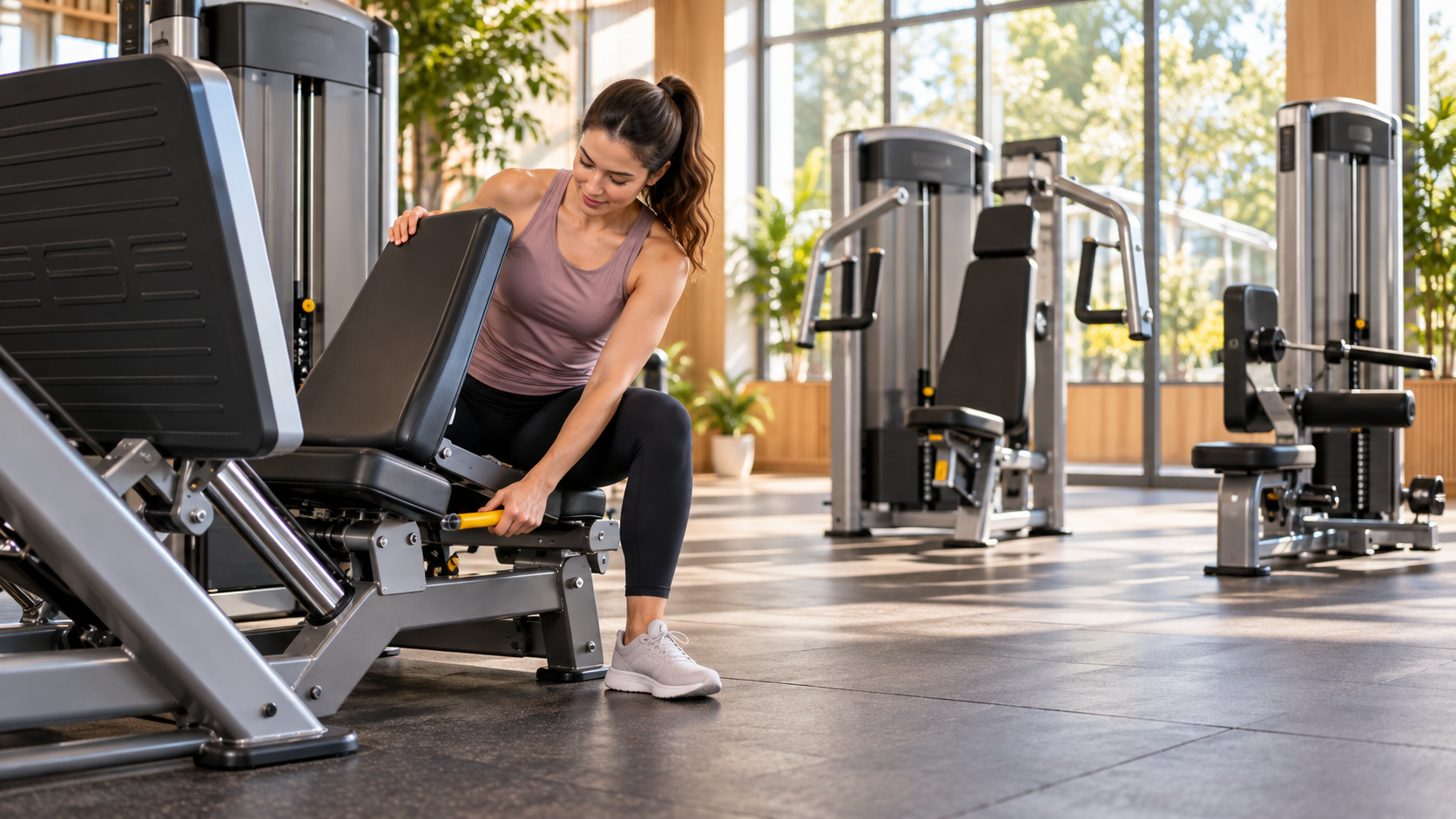
If you can train three days a week, practising the whole body each time is a clear option. It does not mean taking every muscle to failure on every visit. Repeat fundamental lower-body, pushing and pulling movements across the week and distribute work according to your time and recovery. Rather than a timetable to copy blindly, this guide offers a way to adapt the programme to your equipment and real-life schedule.
“Full-body” here means each session includes major lower- and upper-body movements. It does not mean giving every muscle the same number of sets. If you have never used the equipment, ask gym staff to help with setup and technique. Pain, dizziness or symptoms under medical treatment should not be “fixed” by following a generic workout. This is not an injury or disease prescription.
Is full-body training better than a split?
A 2024 systematic review and meta-analysis compared full-body and split routines and found no clear difference in strength or hypertrophy when weekly training volume was matched. It did not establish full-body training as the one correct approach. It can suit someone who can reliably make three visits, while a different division may suit someone who cannot tolerate a long single session.
The 2026 American College of Sports Medicine overview likewise describes benefits from sustained, progressive resistance training. Relatively heavy practice matters for strength and factors such as weekly volume matter for hypertrophy; the name of a split is not a prerequisite. As our article on frequency and weekly sets explains, count working sets by body region instead of judging a plan by its calendar label.
Define the week’s available space first
Check whether three sessions, including travel, are truly available and how long each can be. Monday, Wednesday and Friday are easy to picture, but fixed weekdays are not mandatory. Where possible, avoid placing all demanding sessions back-to-back; time between them helps you notice how technique and fatigue are developing. If work forces consecutive days, you need not load the same movements heavily every day—adjust work and intensity.
Also avoid adding so many exercises that each visit becomes a marathon. One main lower-body movement, one upper-body push and one pull give a useful framework; add a hip hinge or trunk exercise where appropriate. Squats are not compulsory: a controlled leg press may fit your equipment and ability better. Our machine setup guide explains how to make equipment settings repeatable.
An illustrative three-day layout
This is an editorial example for a generally healthy adult, not an individually tested prescription. Sets, reps and loads must be adapted. A beginner may start with fewer exercises while learning technique. Follow the equipment instructions and staff advice before this table.
| Day | Main lower-body movement | Upper-body push and pull | Extra check |
|---|---|---|---|
| A | Leg press, 2 sets of 8–12 reps | Chest press and seated row, 2 sets of 8–12 each | Record seat position and movement range |
| B | Hip-hinge machine, 2 sets of 8–12 | Shoulder press and lat pulldown, 2 sets of 8–12 each | Adjust to fatigue from A |
| C | Leg press or another leg exercise, 2 sets of 8–12 | Chest press and a row, 2 sets of 8–12 each | Compare technique with A |
Do not conclude mechanically that “two lower-body sets on three days equals six sets for every leg muscle.” Direct and indirect contributions depend on the exercise and the muscle considered. Day B has less knee-bending work; you may add or swap a leg movement if goals and time justify it. If overhead pressing does not feel appropriate for your shoulder, do not force it—ask about another pushing exercise. The table is a framework to edit, not a finished personal prescription.
How to run one session
Begin by moving comfortably and trying the equipment at a light load; check seat, grip and movement range. The two sets in the table illustrate working sets. You may also need lighter practice sets. Placing the larger or highest-priority movement early lets you practise it before fatigue accumulates. If hurrying between exercises ruins subsequent form, rushing to save time is counterproductive.
Do not select a load mechanically because “eight must be the maximum possible.” First check whether you can perform eight to twelve controlled reps, leave some room rather than forcing every set to failure, and compare the same conditions next time. Our rep-range guide treats a range as a training tool, not an absolute boundary. If reps collapse in later sets, review rest and exercise order as well as load.
A four-week adjustment example
In week one, complete the A, B and C days without rushing and log the machine, setup, load and reps. In week two, aim to reproduce the movements without major changes. In week three, see whether you can add a rep to some working sets while holding technique steady. In week four, if a movement is consistently near the top of its chosen range, you may try a small load increase next time. No rule says every exercise must progress every week.
If a week loses one session, do not squeeze all its missed work into one visit. You can do the two feasible sessions and return to the plan the next week. If three days repeatedly cost you sleep, a two-day full-body plan may be more sustainable. If each visit becomes too long, reduce optional exercises or spread them across another available day. Check that weekly working sets by muscle do not rise unexpectedly.
TRAINING PRESS and GROWTH are both operated by GOODBOY STUDIOS. Logging the exercises, loads, reps and sets of A, B and C in GROWTH gives you comparable material the following week. This does not mean the app creates a personal safe prescription or diagnoses pain. Add notes about movement and fatigue where available, and consult staff or a clinician when appropriate.
Common questions
Must the same exercises be repeated on every full-body day?
No. Repeating them makes progress easier to compare, but suitable alternatives can fit your goal or equipment availability. Record a change as a different condition rather than assuming the numbers are directly comparable.
Does missing one of the three days erase progress?
One missed day does not invalidate the overall effort. Do not double the next workout to compensate. Return to a schedule you can sustain.
Do all working sets need to go to failure?
No. Choose a stopping point that preserves technique, later sets and recovery. Our guide to RIR can help you describe the effort.
Takeaway
A three-day full-body routine repeats lower-body, pushing and pulling work across the week and makes exercises easier to compare. It is not automatically superior to a split. Begin with a realistic time budget and a small number of basic movements, then adjust working sets, technique and recovery from about four weeks of records.
References
- Ramos-Campo DJ, et al. Efficacy of Split Versus Full-Body Resistance Training on Strength and Muscle Growth: A Systematic Review With Meta-Analysis. Journal of Strength and Conditioning Research. 2024;38:1330–1340. doi:10.1519/JSC.0000000000004774. https://pubmed.ncbi.nlm.nih.gov/38595233/
- Currier BS, et al. American College of Sports Medicine Position Stand. Resistance Training Prescription for Muscle Function, Hypertrophy, and Physical Performance in Healthy Adults: An Overview of Reviews. Medicine & Science in Sports & Exercise. 2026;58:851–872. doi:10.1249/MSS.0000000000003897. https://pubmed.ncbi.nlm.nih.gov/41843416/