Is the barbell squat the only “real” way to train legs, with the leg press merely a substitute? Or does a machine make technique and safety automatic? Neither claim holds. Both exercises involve the hips and knees, but body support, equipment constraints and the skill measured by a test differ. Choose from your goal, available equipment and ability to repeat a controlled movement.
This is an exercise-selection guide for generally healthy adults, not a diagnosis or a return-from-injury plan. If you have dizziness, joint pain or a relevant medical history, do not test heavy loads on your own; ask a clinician and appropriately qualified coach. Nor is one foot position or seat setting a universal answer.
Research does not name one winner for every outcome
In a study published in 2018, participants were allocated to squat-only, leg-press-only or combined lower-body training for ten weeks, twice weekly. The squat group improved maximal squat strength more than the leg-press group. Functional measures showed different trends, and some between-group differences were not statistically clear. The lesson is exercise specificity: practice close to the task you wish to improve tends to transfer better to that task’s test.
Another eight-week study, published in 2017, compared barbell squats with leg presses and found greater improvements in certain jump tasks after squat training. It does not imply that machines cannot build muscle. A 2023 study comparing several free-weight exercises with their machine-based counterparts for eight weeks found muscle cross-sectional area increased in both groups without a clear difference between them. That was not a direct squat-versus-leg-press hypertrophy trial, so it cannot prove identical leg growth from these two exercises in every situation.
Participants, duration, machines and training background matter. Decide what you want to improve before ranking the exercise names.
When to make the squat your main movement
If you want to improve barbell-squat skill or maximal squat strength, practising the squat itself has a clear purpose. Your task is to repeat bar placement, balance, depth and ascent under reasonably similar conditions. Someone preparing for a sport or assessment that specifically requires the squat should not expect leg presses alone to reproduce that skill.
Choosing the squat does not mean starting heavy. Learn the movement with a manageable load; follow the facility’s rules for rack safeties, space and assistance. If skill takes time, combine light squat practice with another leg exercise. There is no single ideal depth or stance for every body. Work within a range you can control without pain and seek individual guidance where needed.
When to make the leg press your main movement
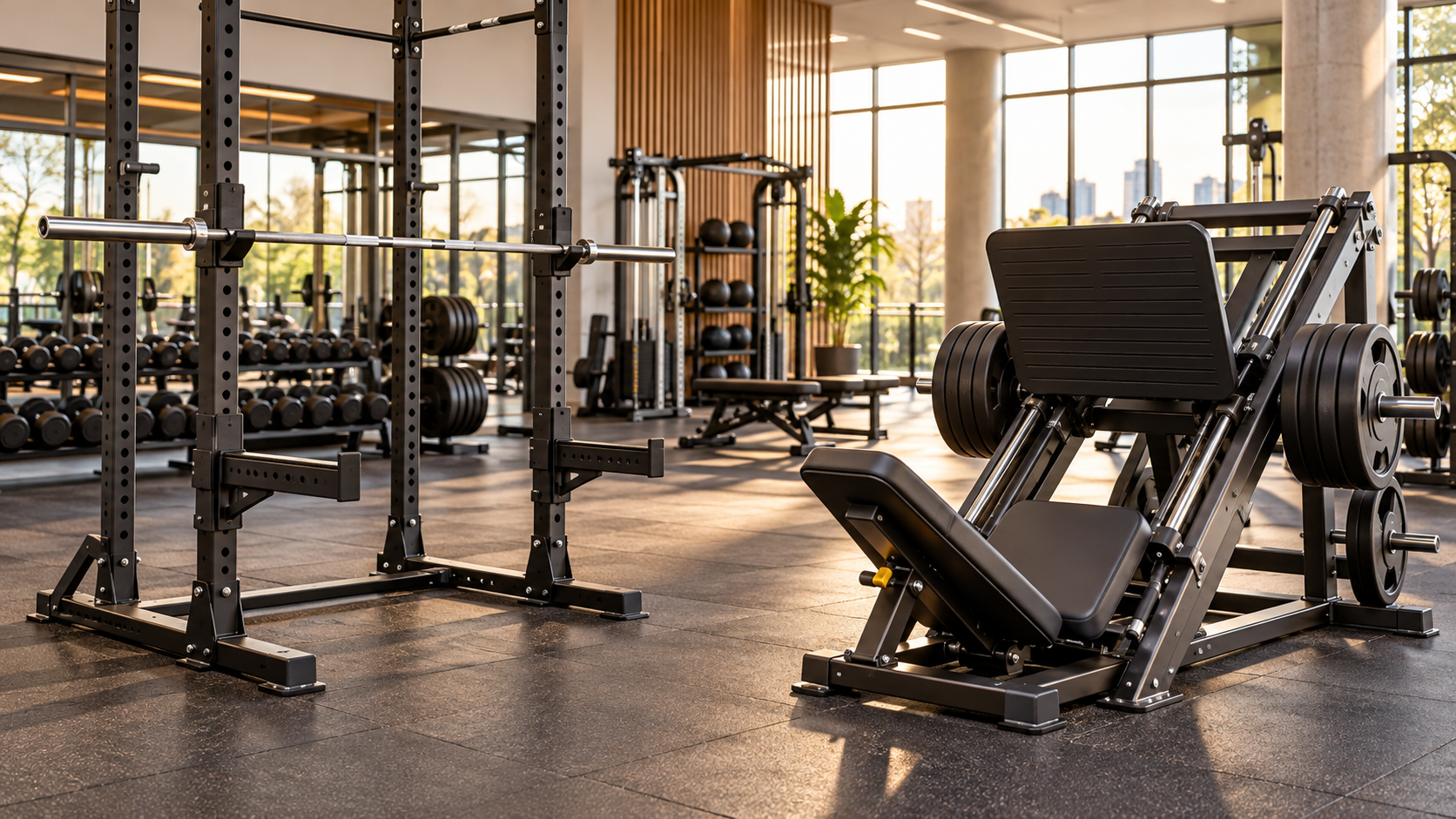
Sitting against a backrest reduces some demands of holding a barbell and balancing the whole body. This may make it easier for a beginner to repeat leg working sets, or allow extra leg work alongside squat-skill practice. Yet “machine” does not mean “automatically safe”. Follow instructions for the particular model and check the stops, seat, starting position and range. If forcing a bigger range makes your pelvis or back position unstable, review the setup rather than pursuing a deeper number at any cost.
Do not compare plates on a leg press directly with the barbell weight in a squat. Machine angle, resistance mechanism and starting load vary. Our machine-setup guide explains how to track progress within the same model.
| Question | Squat may fit when… | Leg press may fit when… |
|---|---|---|
| What is the target? | Squat skill and strength matter | Repeatable leg work on stable equipment matters |
| What must stay consistent? | Bar, depth, position and rest | Machine, seat, start and range |
| What limits access? | Rack, coaching and balance practice | Machine availability, adjustments and instructions |
| How does it fit the session? | Skill practice may come first | Can add a few accessory leg sets |
If you use both
A person training legs twice weekly could make session A two squat working sets with an emphasis on skill and session B two leg-press working sets. Another option is to squat first and perform a small amount of leg press afterwards. Neither schedule is a uniquely proven prescription. The key is to count both as leg work instead of accidentally doubling your workload. Our guide to weekly sets can help you audit that total.
At first, keep the number of exercises and sets manageable enough to learn each movement. Use a practical rep range and repeat comparable sessions over several weeks. A log showing a 40 kg squat for eight and an 80 kg leg press for ten does not mean the leg press is “twice as strong”. Treat them as separate histories; review movement quality and fatigue for each.
TRAINING PRESS and GROWTH are operated by GOODBOY STUDIOS. Log exercise, weight, reps and sets in GROWTH so squat and leg-press histories do not get mixed. We do not claim the app diagnoses pain or guarantees safe machine settings. Note machine model and setup separately as needed.
Common questions
Can the leg press train my legs on its own?
It can contribute meaningful leg work. But if the objective is squat technique or maximal squat strength, practise that specific movement too. Choose other exercises according to the muscle groups and goals that remain.
Can I convert a leg-press number into a squat weight?
Not with a simple formula. Machines, angles and range differ. Compare a lift with its own previous sessions on the same equipment.
Which is safer if my knees or back hurt?
An exercise name does not diagnose pain or establish individual safety. Seek clinical advice before testing heavy loads with symptoms, and get instruction on equipment use.
Takeaway
Squats and leg presses are not “real exercise versus substitute”. They are lower-body tools with different tasks and constraints. Practise squats if squat performance matters; use a leg press when stable, repeatable leg sets suit your plan. If you use both, account for their combined workload and fatigue, and keep each exercise’s setup and progress records separate.
References
- Rossi FE, et al. Strength, body composition, and functional outcomes in the squat versus leg press exercises. Journal of Sports Medicine and Physical Fitness. 2018;58:263–270. doi:10.23736/S0022-4707.16.06698-6. https://pubmed.ncbi.nlm.nih.gov/27735888/
- Wirth K, et al. Effect of 8 weeks of free-weight and machine-based strength training on strength and power performance. Journal of Human Kinetics. 2016;53:201–210. doi:10.1515/hukin-2016-0023. https://pubmed.ncbi.nlm.nih.gov/28149424/
- Hernández-Belmonte A, et al. Free-Weight and Machine-Based Training Are Equally Effective on Strength and Hypertrophy: Challenging a Traditional Myth. Medicine & Science in Sports & Exercise. 2023;55:2316–2327. doi:10.1249/MSS.0000000000003271. https://pubmed.ncbi.nlm.nih.gov/37535335/