Squat advice can sound contradictory: stop when your thighs are parallel, or descend as far as you can. Depth is not a single instruction detached from your goal, anatomy, stance and load. A partial squat is not automatically worthless, nor does everybody need to take a heavy barbell to the deepest possible position. Start by finding a range you can control without pain, with a stable foot position and a movement you can repeat. Then consider whether a different depth would better serve the outcome you seek.
This article is general training information for otherwise healthy adults. It is not rehabilitation guidance for a painful knee, hip or back, or for someone recovering from surgery. Stop rather than push through pain, numbness or dizziness and consult a qualified clinician or coach where appropriate.
What the research does, and does not, show
A small 2013 trial assigned 17 male students to deep or shallow squat training for 12 weeks. The deep group had larger increases in the measured front-thigh muscle cross-sectional area and an advantage on strength in the deeper movement. The trial does not establish that everybody needs the deepest possible squat, that partial training has no value, or that a specific depth prevents injury. Its participants, measured muscles and training conditions limit the inference.
Another experiment, published online in 2019, assigned 53 trained men to full, parallel, half-squat or no-training groups for ten weeks. Their individual ranges and spinal positions were established during familiarisation and reproduced during training. Full squats showed certain neuromuscular and functional advantages under those study conditions. The title also mentions less pain, but that outcome should not be turned into a promise of treatment for a reader who already has pain. Nor does it define a universal angle for everyone.
Three-dimensional movement analysis in 42 novice and experienced squatters found that changing stance width and foot direction changed hip and knee joint moments. The investigators warned about certain extreme combinations. This is a reason to consider stance and load along with depth, not evidence that one foot angle is safe for all bodies. A laboratory measure of joint loading cannot diagnose an individual’s injury risk.
Reduce the load before exploring the range
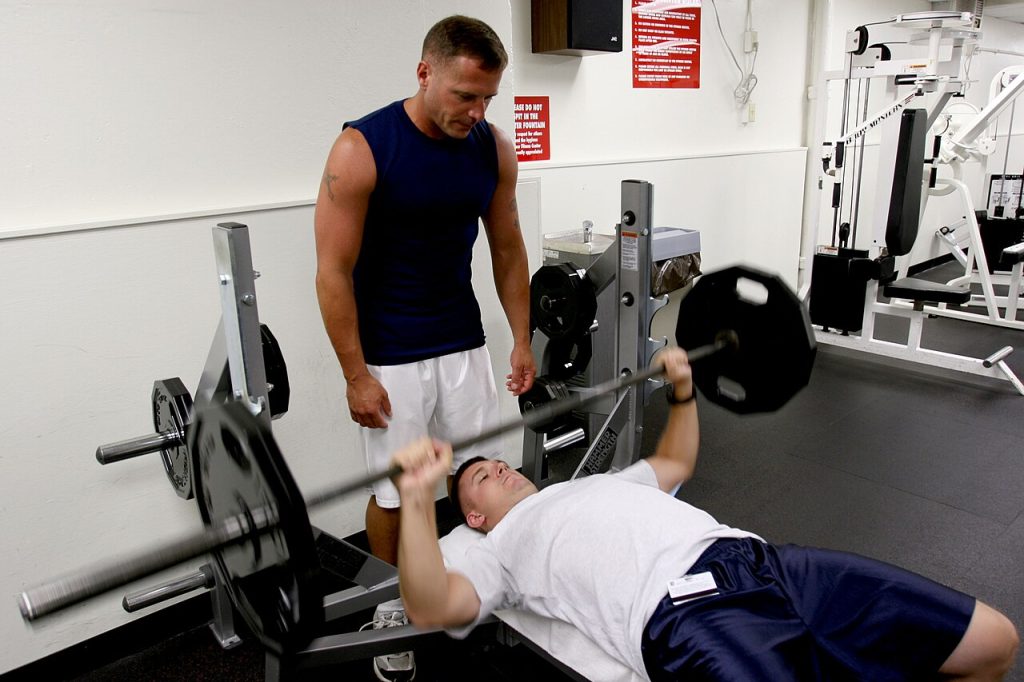
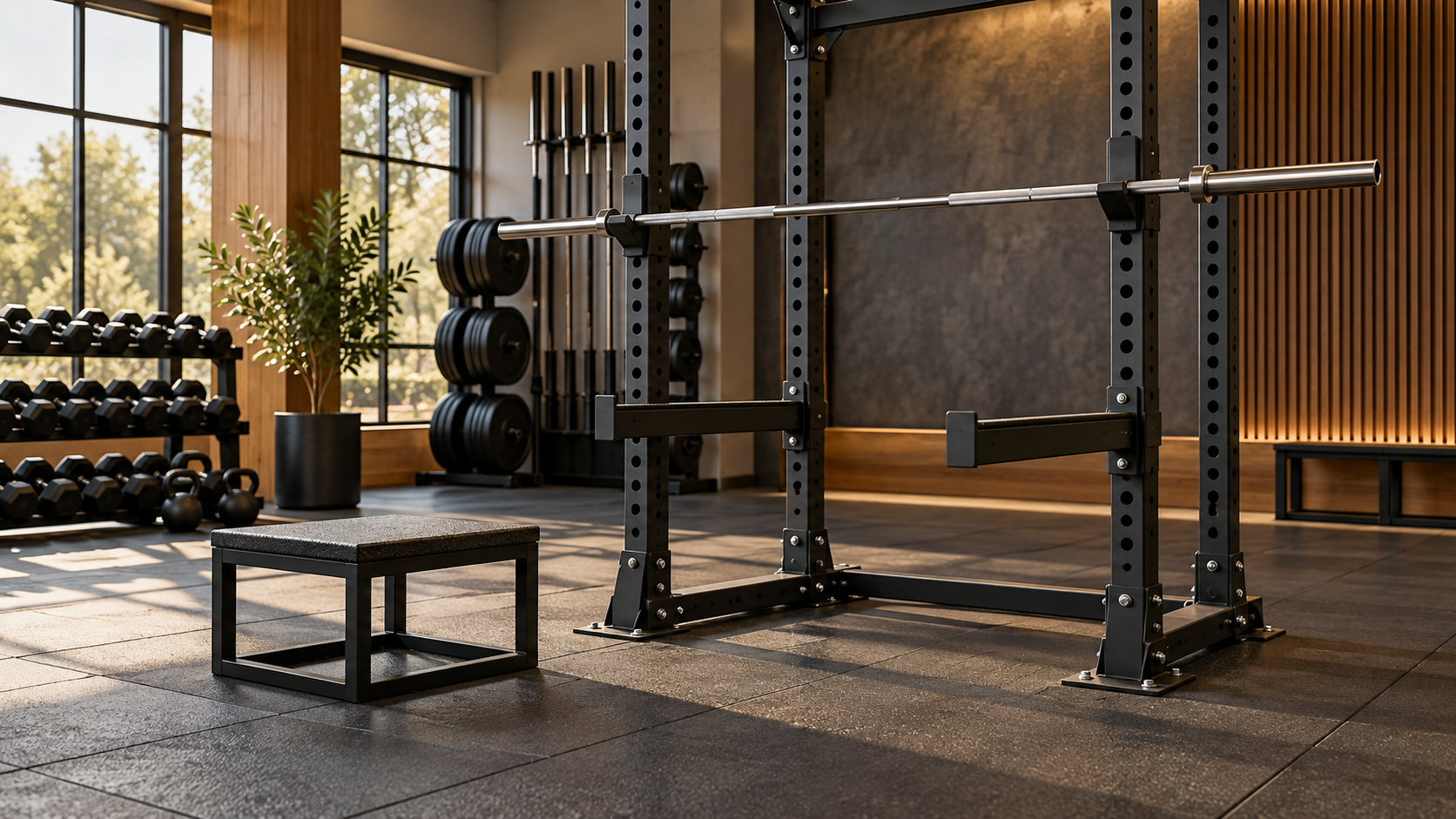
Trying an unfamiliar depth in the middle of a heavy set combines movement exploration with the challenge of managing a large load. Set the rack and safeties appropriately, learn how to return the bar, and seek coaching if needed. Then explore with body weight, a light goblet squat or an appropriately light bar. Do not test a maximal load without knowing how the safety system works. A chair target or a suitable machine can also help make the intended depth repeatable.
Check whether your whole foot remains stable rather than forcing a universal rule about heels, toes or knees. The knee moving forward of the toes is not, by itself, proof of a mistake or injury. Trunk angle varies with proportions and bar position. However, if your feet lose contact, control deteriorates rapidly, or pain occurs as you descend, return to an easier range or load. A small change in pelvic position on video alone cannot diagnose tissue damage, but a sudden marked change is a reason to reassess technique and load.
Define depth in a way you can reproduce. A side video is more useful when camera height and distance stay similar. Record an identifiable chair height, an approximate thigh position or a position at which you retain control without pain. Comparing two people’s still photographs may mislead when anatomy and camera angle differ. The aim is not to win a visual contest; it is to know whether today’s working sets resemble your previous ones.
A three-session example for testing depth
The following is an editorial example for a healthy novice with a suitable training environment, not a tested three-session protocol or a personal prescription. Your workable load and repetition count may differ. Change one condition at a time and keep the option to step back.
| Session | Example trial | What to record | Reason to proceed |
|---|---|---|---|
| 1 | Body weight or light load; touch a chair for 2 sets of 6–8 | Stance, foot contact, pain, side-video position | Repeatable control at that depth |
| 2 | Same load; lower the chair slightly or descend a little farther without it | Descent speed, balance and abrupt postural changes | No pain or loss of control |
| 3 | Fix the chosen depth for 2–3 sets of 6–8 | Load, reps, effort and depth | Compare with a later matched session |
If the second session feels unstable, returning to the first depth is a valid choice. Adding load may also unintentionally shorten the range. A bigger number on the bar then does not represent the same test. Record both weight and depth, and do not add load, depth and sets all at once if you want to understand what changed.
Let the goal guide the choice
For muscle growth, it is reasonable to consider a controlled, substantial range that trains the intended muscles. The small depth comparison offers evidence for front-thigh benefit, not a guarantee that every muscle responds identically. If another leg exercise suits your situation better, our squat versus leg-press comparison separates their demands and limitations.
For a strength test at a particular depth, practice and assessment should use comparable depths. A heavy above-parallel set is not directly the same personal best as a below-parallel set. The guide to progress beyond load also stresses recording the movement conditions. If depth changes unexpectedly from one session to another, check fatigue, stance, footwear, equipment and load before labelling the day a failure.
Do not make depth an end in itself. Pushing through pain to descend farther, or raising volume and load at the same time, is not demanded by the evidence. A stable, repeatable range can be a sensible place to train. If your sport has a formal depth rule, consult its actual rulebook; this general article does not determine a valid competition attempt.
TRAINING PRESS and GROWTH are both operated by GOODBOY STUDIOS. You can log exercise, load, reps and sets in GROWTH, then keep a note of the stance and depth you actually used. That helps distinguish genuine progression from a changed range. We do not claim the app automatically diagnoses form from video.
Common questions
Are my knees wrong if they go beyond my toes?
Not on that observation alone. Body proportions, stance, depth and load influence the movement. Pain or a loss of control is a reason to reconsider the load and technique.
Is training useless if I cannot reach parallel?
No. Some studies show advantages for a deeper range, but they do not make all shorter-range practice useless. Choose a suitable controlled range and compare matched sessions.
Can I compare a set after changing depth with last week’s load?
It is useful context, but not the same test if range changed. Record depth, stance and equipment, and compare like with like.
Takeaway
There is no single depth that can be prescribed to every squatter. Trials show potential advantages for deeper training, while movement studies show that stance and loading also change the demands. Explore at a manageable load, adopt a controlled pain-free range, and adjust gradually in line with your goal. Log depth and stance as well as the weight on the bar.
References
- Bloomquist K, et al. Effect of range of motion in heavy load squatting on muscle and tendon adaptations. European Journal of Applied Physiology. 2013;113:2133–2142. doi:10.1007/s00421-013-2642-7. https://pubmed.ncbi.nlm.nih.gov/23604798/
- Pallarés JG, et al. Full squat produces greater neuromuscular and functional adaptations and lower pain than partial squats after prolonged resistance training. European Journal of Sport Science. 2020;20:115–124. doi:10.1080/17461391.2019.1612952. https://pubmed.ncbi.nlm.nih.gov/31092132/
- Lorenzetti S, et al. How to squat? Effects of various stance widths, foot placement angles and level of experience on knee, hip and trunk motion and loading. BMC Sports Science, Medicine and Rehabilitation. 2018;10:14. doi:10.1186/s13102-018-0103-7. https://pubmed.ncbi.nlm.nih.gov/30026952/