The Bulgarian split squat, also called the rear-foot-elevated split squat, is a single-leg-dominant exercise with the back foot supported on a bench. But if you pick up heavy dumbbells before you can hold a steady position, the session can become a balance test rather than useful leg practice. Instead of searching for one mandatory bench height or a rule that the front knee must never pass the toes, establish a stance with an ordinary floor split squat, then find a supported movement you can reproduce.
This article gives general exercise information for healthy adults. Prioritize individual medical or qualified coaching advice for knee, hip, ankle or back pain and conditions. The purpose is not to push through pain to reach greater depth. Choose a stable, nonslip support with space around you. If you feel you may fall, return the rear foot to the floor and stop.
Single-leg dominant does not mean the back leg disappears
In a study published in 2022, 26 men with at least two years of supervised training experience performed rear-foot-elevated split squats. Separate force plates showed that the front foot produced an average of approximately 84% of the combined vertical force. This does not mean the rear leg does nothing; under the tested conditions, the front leg provided the main support and force. Do not apply that percentage as a fixed value to novices, another bench height or someone in rehabilitation.
In a 2021 study, 20 resistance-trained men performed back squats and Bulgarian split squats while investigators compared joint movement and moments. The external loads were 70% and 35% of back-squat one-repetition maximum, respectively. The exercises had different mechanical profiles at the ankle, knee and hip, with less knee displacement in the tested Bulgarian split squat condition. This was an acute mechanics comparison, not evidence that the split squat prevents knee injury. Nor should the two exercises’ weight numbers be equated.
An 11-person EMG study compared three unilateral exercise variations and found that measured muscle activity can differ by exercise. That one-session signal cannot rank which exercise will produce the most hypertrophy over months. This guide does not prescribe a magic “glute angle”; it concentrates on a controllable starting sequence.
Begin on the floor before raising the back foot
Place one foot forward and one back, with both feet on the floor, and try a split squat. You may lightly hold a wall or fixed rail for balance. Do not grip a moving bench, unstable box or rolling implement. Keep the front sole in contact with the floor, lower slowly as the legs bend naturally, and stand back up within a manageable range.
If the stance feels cramped, lengthen it a little; if the hip or back feels uncomfortably stretched, reconsider the distance. Your feet do not have to be on a single tightrope line. Leave some side-to-side space between them and find a stance that limits large pelvic and trunk sway. “The knee must never pass the toes” is not a universal safety criterion. Joint shape, stance and task all matter. If you have pain, do not force an angle; stop and seek appropriate help.
Decide on height and support before loading
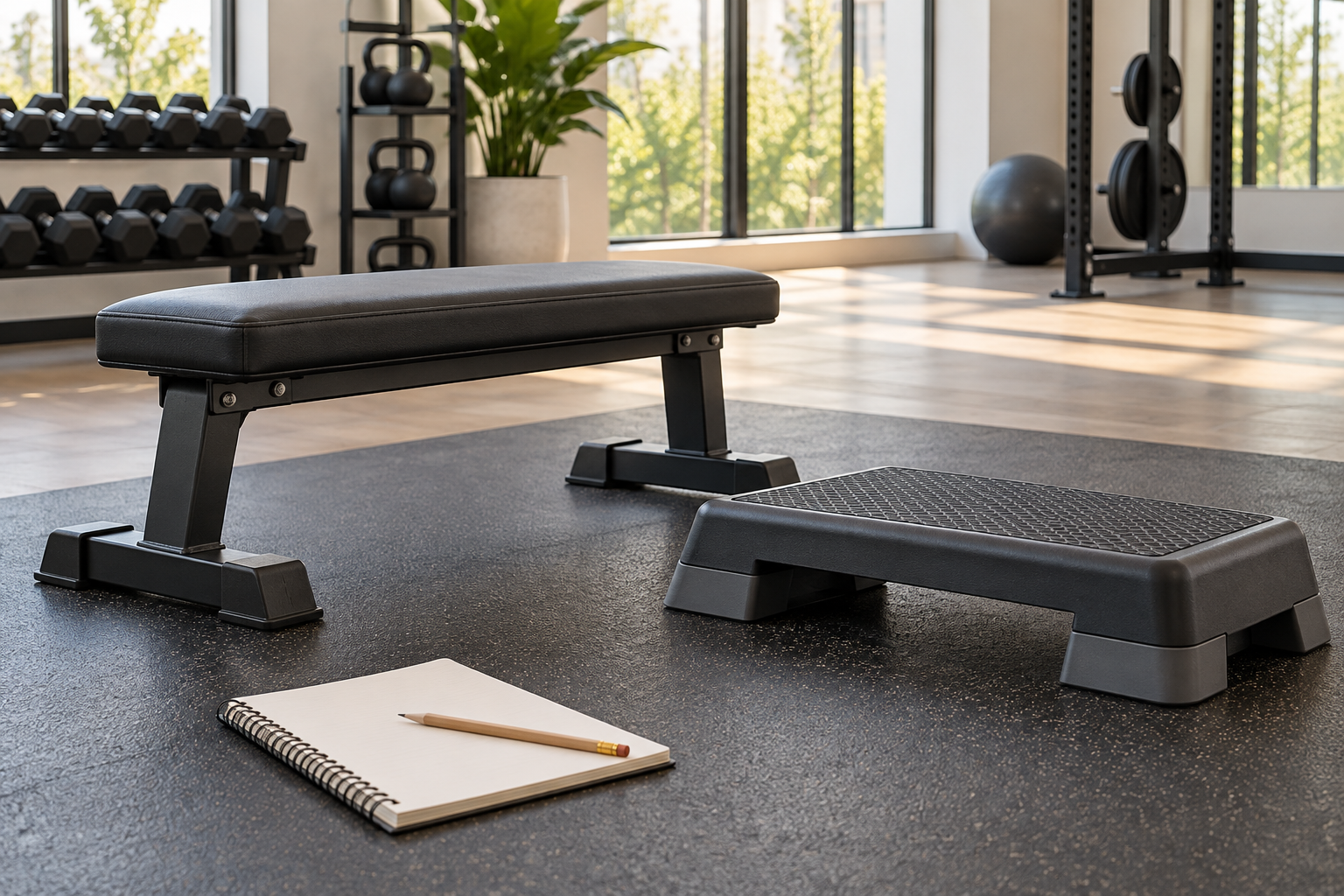
When the floor movement is steady, rest the back foot lightly on a low, secure box or bench. There is no one correct height for every body. If a high support pulls uncomfortably on the front hip or rear leg, lower it or return to a floor split squat. The back foot supports the position, but you need not force an ankle bend or toe orientation. Check whether your shoe slips on the surface.
Once the front foot and back support are positioned, pause to check your balance. It is usually better to step out and reset than to make a large adjustment in the middle of a repetition. If you still sway when you spread your arms, use a fixed hand support or bring the back foot down. Lower only as far as you can keep the front sole and pelvis controlled, then stand without bouncing. You do not need to arch the lower back to reach extra depth or lift the front heel.
A three-session practice example
This is a fictional editorial example, not a universal set, rep or load prescription. Use support if needed, stay in a pain-free range and rest until breathing and position recover between sets.
| Stage | Example | Check |
|---|---|---|
| First session: floor | Supported split squat, 2 sets of 6 on each side | Front-foot contact, stance width and pain |
| Second: support | Back foot on a low, steady support, 2 sets of 6 each side | Balance and repeatable depth |
| Third: comparison | Same support and front-foot location, try 2 sets of 8 each side | More consistent control and whether extra load is needed |
If moving to the support makes the second session unstable, go back to the first step rather than adding repetitions. Even after two steady sets of eight in session three, there is no need to jump straight to heavy weights. For example, after repeating bodyweight sets you might trial a 2 kg dumbbell in one hand through the same range; the right load depends on strength and safe handling. Do not remove your hand support and add weight on the same day.
Record left and right sides under matching conditions
Eight repetitions on one side and six on the other do not diagnose a displaced pelvis or abnormal weakness. Order, rest, front-foot position, depth, support height and hand support can change the result. First match those conditions and observe the repetition count and movement control on each side across several sessions. Seek individual evaluation if a large difference or pain persists. Do not automatically pile many extra sets onto the weaker side to “make up” the number.
Also avoid comparing its load directly with a two-legged squat. As our squat-depth guide explains, movement range and position change the meaning of a load. When planning weekly leg work, use the upper/lower split example to consider the leg exercises already in the program rather than adding overlapping work blindly.
TRAINING PRESS and GROWTH are both operated by GOODBOY STUDIOS. Record sets, reps and load for each side in GROWTH, and note the support height, front-foot marker and whether you held something stable. We do not claim that the app diagnoses form or side-to-side asymmetry. A matched log helps you choose one adjustment next time.
Frequently asked questions
Is it a failure if I cannot put my back foot on a bench?
No. A floor split squat is also an option. Sustained, comfortable leg training matters more than elevating the rear foot.
Must the front knee stay behind the toes?
There is no absolute prohibition for everyone. The knee path varies with stance, body shape and purpose. If pain or control is a problem, reconsider load and range and consult a professional when needed.
When should I hold dumbbells?
First reproduce a bodyweight movement several times with the same support and stance and make sure a change in hand support remains stable. There is no mandatory repetition threshold at which load must be added.
Takeaway
Start with a floor split squat to establish stance and support, progress to a low stable rear-foot support, repeat the bodyweight range and only then consider external load. Research suggests the front foot does most of the measured vertical work and shows mechanical differences from the back squat, but does not guarantee a personal safe angle or future muscle growth. Log the support, foot position, hand support and repetitions on each side. Never ignore pain or major loss of balance.
References
- Helme M, et al. Is the Rear Foot Elevated Split Squat Unilateral? An Investigation Into the Kinetic and Kinematic Demands. Journal of Strength and Conditioning Research. 2022. doi:10.1519/JSC.0000000000003727. https://pubmed.ncbi.nlm.nih.gov/32796420/
- Mackey ER, Riemann BL. Biomechanical Differences Between the Bulgarian Split-Squat and Back Squat. International Journal of Exercise Science. 2021. doi:10.70252/CIYT8956. https://pubmed.ncbi.nlm.nih.gov/34055144/
- Mausehund L, et al. Muscle Activation in Unilateral Barbell Exercises: Implications for Strength Training and Rehabilitation. Journal of Strength and Conditioning Research. 2019. doi:10.1519/JSC.0000000000002617. https://pubmed.ncbi.nlm.nih.gov/29870422/